The cybersecurity threats Wisconsin manufacturers face are no longer limited to stolen files or suspicious emails. When ransomware hits a production environment, it can escalate fast: CNC machines stop receiving job files, shipping slows down, ERP data becomes unavailable, supervisors lose visibility into work orders, and the plant floor starts making decisions with incomplete information.
That is why manufacturing has become such an attractive target. Attackers know many manufacturers run lean IT teams, older production systems, remote vendor connections, and tight delivery schedules. A bank can freeze transactions. A manufacturer may have to stop a line.
National threat data now backs up what many Wisconsin IT directors already feel: manufacturing is under heavier pressure than most industries. IBM reported that manufacturing was the most attacked industry for the fourth consecutive year in 2024, with the highest number of ransomware cases among industries it tracked.
The Numbers: What the Threat Data Means for Wisconsin Manufacturers
The clearest takeaway from the 2023–2025 data is this: ransomware is now an operations problem, not just an IT problem.
Dragos documented 1,693 ransomware attacks against industrial organizations in 2024, an 87% increase over the prior year, and found that 75% of ransomware incidents it responded to caused a partial OT shutdown while 25% caused a full OT shutdown.
For a Wisconsin manufacturer, that can mean delayed shipments, overtime recovery, missed contract obligations, and customer confidence problems.
Verizon’s 2025 manufacturing breach data also shows why mid-sized manufacturers are exposed. In manufacturing breaches, ransomware appeared in 47% of cases, stolen credentials in 34%, exploited vulnerabilities in 23%, and phishing in 19%. Verizon also found that more than 90% of breached manufacturing organizations in its sample were SMBs with fewer than 1,000 employees.
That matters because many Wisconsin manufacturers operate exactly in that range: large enough to be valuable, but not large enough to run a 24/7 security operations center. Zscaler’s 2025 ransomware research found manufacturing was the most frequently hit sector in its data, with 1,063 attacks over the prior year, while U.S. victims accounted for 50% of ransomware attacks globally.
Locally, the 2023 ransomware attack involving Fincantieri Marinette Marine showed what that risk looks like on the shop floor. USNI News reported that the attack affected servers used to feed instructions to CNC manufacturing machines and knocked some systems offline for several days.
How Attackers Get In
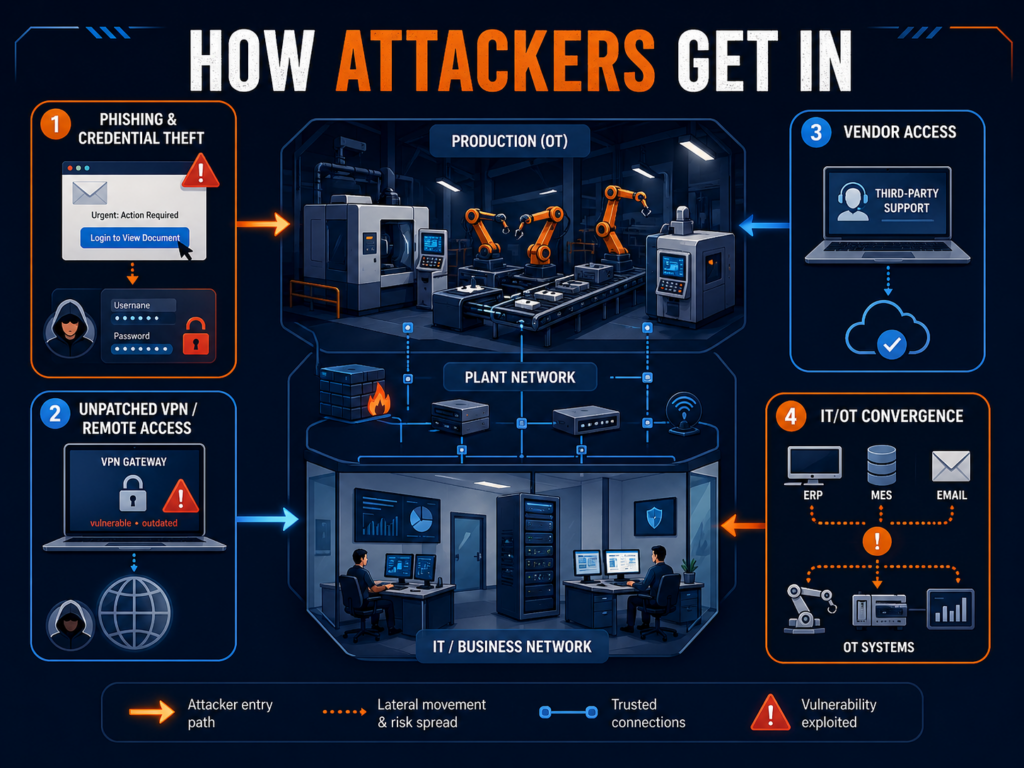
Most manufacturing ransomware attacks do not start with movie-style hacking. They start with access that should have been harder to use, easier to monitor, or closed months ago.
1. Phishing and Credential Theft
A phishing email in a manufacturing business rarely looks like a generic scam. It may look like a supplier invoice, a freight update, a customer drawing, a quote request, or a Microsoft 365 login prompt sent to a plant manager rushing between meetings.
Once attackers capture a password, they try to log in like a real employee. IBM reported that stolen credentials surged 71% year over year and represented 30% of incidents it responded to in 2023, tied with phishing as the top infection vector.
In a plant environment, that one login can lead to email access, file shares, ERP systems, CAD files, or maintenance documentation. If multi-factor authentication is missing from VPN, admin accounts, or email, the attacker’s job gets much easier.
2. Unpatched VPN and Remote Access
Manufacturers rely on remote access for good reasons. Engineers connect after hours. Vendors support equipment. IT teams troubleshoot without driving to the plant. The problem is that VPNs, firewalls, and remote access portals are some of the first doors attackers check.
Verizon’s 2025 SMB snapshot noted that exploitation of vulnerabilities has become the most common initial access vector in ransomware breaches, driven heavily by attacks on perimeter devices.
For manufacturers, the risk is not just “someone got into the network.” The risk is that an old VPN account, unpatched firewall, or shared vendor login gives an attacker a path toward the systems production depends on.
3. Vendor Access
Manufacturing runs on outside access: machine vendors, ERP consultants, managed software providers, maintenance contractors, logistics platforms, and sometimes customers with portal access. Each relationship may be necessary. Each one also creates a door.
The issue is usually not that vendors are careless. It is that access is often granted once and reviewed rarely. A vendor account may stay active after a project ends. A shared login may exist because “that’s how the machine vendor set it up.” A remote support tool may be installed on a workstation nobody has inventoried.
When attackers find those paths, they do not need to break down the front door. They walk in through a service entrance.
4. IT/OT Convergence
The phrase OT IT security manufacturing sounds technical, but the business issue is simple: the office network and production network are now more connected than they used to be.
ERP talks to scheduling. Scheduling talks to production. Engineers push files to machines. Supervisors pull reports from plant-floor systems. Remote monitoring tools collect equipment data.
That connectivity helps manufacturers move faster, but it also gives attackers more ways to turn an IT incident into an operations event. The Fincantieri Marinette Marine incident is a practical example: the impact was not limited to email or back-office disruption; it touched networked operations tied to CNC workflows.
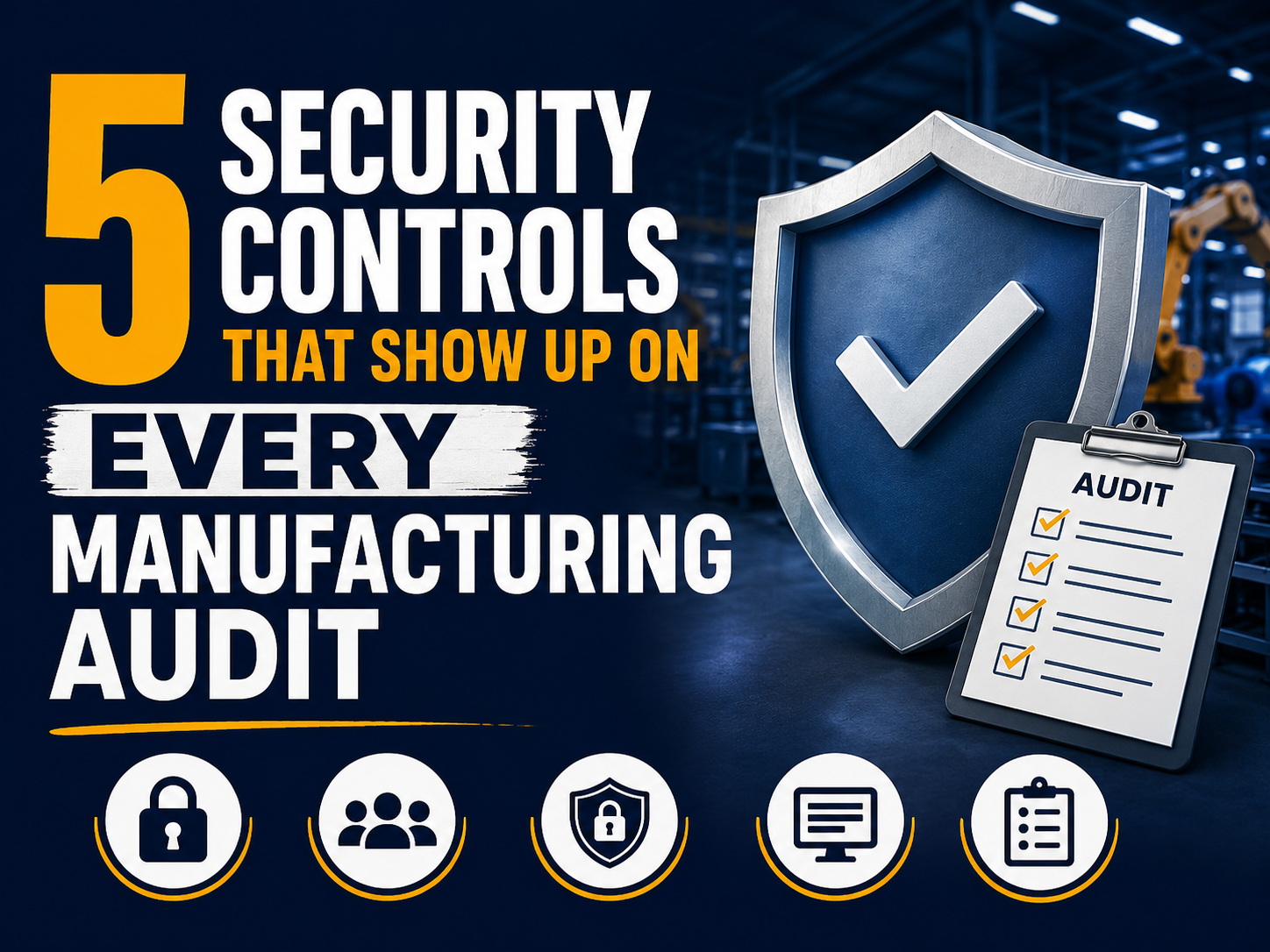
The 5 Gaps Showing Up Again and Again
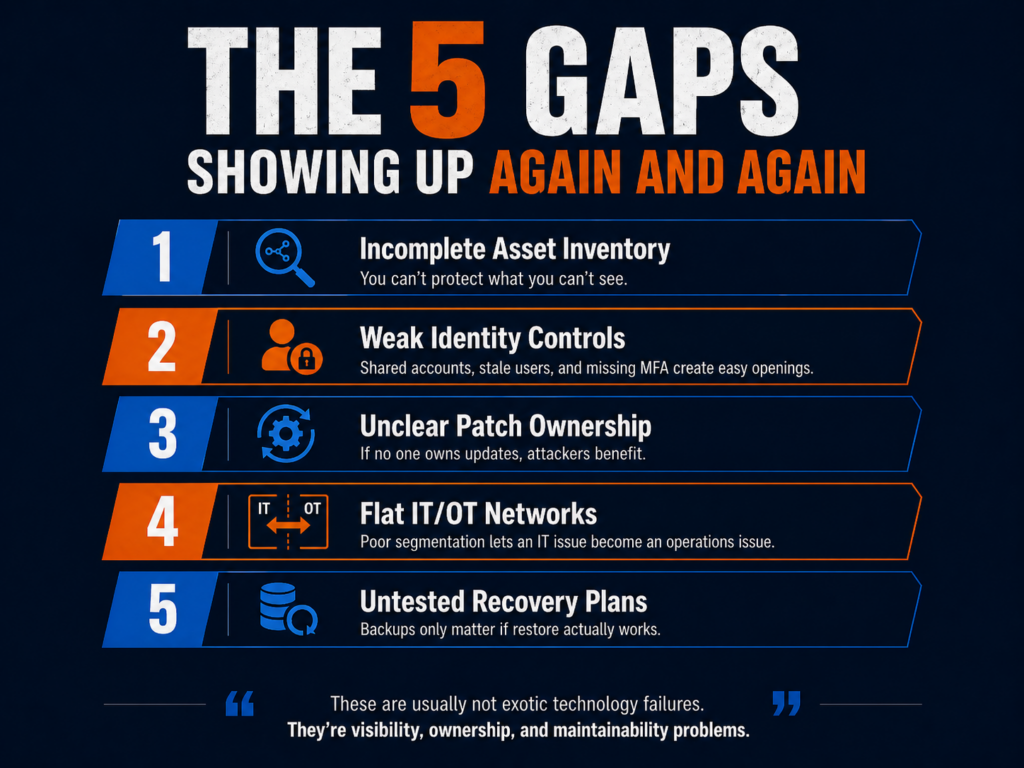
The pattern in the data is not that manufacturers are being beaten by exotic attacks. The pattern is that attackers keep finding the same gaps: access, patching, documentation, segmentation, and recovery.
“The future of the Industrial Heartland depends on its ability to defend the digital code that now governs its physical machines.”
Here are the five gaps Wisconsin manufacturers should pay attention to first.
1. Incomplete asset inventory.
You cannot protect what you cannot see. Many manufacturers know their servers and laptops, but not every vendor tool, engineering workstation, old switch, remote access appliance, or production-connected PC.
2. Weak identity controls.
Shared accounts, stale users, missing MFA, and standing admin rights give attackers room to move. This is especially risky for executives, IT admins, engineers, and vendor accounts.
3. Unclear patch ownership.
IT may patch Windows systems, but who owns firmware, firewalls, VPNs, HMIs, PLC support stations, and vendor-managed equipment? When nobody owns the patching calendar, attackers benefit.
4. Flat networks between IT and OT.
If ransomware can spread from a compromised office workstation into production-adjacent systems, the business has a segmentation problem. Segmentation is not about making the plant harder to use. It is about making a bad day smaller.
5. Untested recovery plans.
Backups are helpful only if they restore quickly and completely. Cyber insurers and customers increasingly expect evidence: restore tests, logs, incident response plans, and documented roles. Current cyber insurance renewal guidance, for example, focuses on MFA, EDR, backup restore testing, and evidence gathering as practical readiness steps.
For defense suppliers, this also connects to compliance. The Department of Defense CMMC program rule became effective December 16, 2024, and phased CMMC implementation began November 10, 2025. For a CMMC Wisconsin manufacturer, cybersecurity documentation is no longer just a best practice. It can affect contract eligibility.
What IT Directors Are Doing About It
Many Wisconsin manufacturers do not need to replace their IT teams. They need to stop asking a small internal team to do every job at once.
That is where the co-managed IT model is gaining traction. Internal IT keeps ownership of the business: users, systems, plant priorities, ERP projects, production needs, and leadership communication. A co-managed cybersecurity partner adds the pieces that are hard to staff internally, such as continuous monitoring, patch compliance tracking, endpoint detection, log review, incident response planning, backup validation, and security documentation.
This model works well for manufacturers because it respects how plants operate. Production cannot wait for a generic enterprise security program. IT needs help that fits maintenance windows, vendor realities, older systems, and uptime requirements.
The best co-managed relationships also produce evidence. That matters for cyber insurance, customer audits, CMMC readiness, and executive reporting. Your co-managed IT partner can provide you with help and documentation around MFA, role-based access, incident response plans, backup testing, vendor controls, and any other cybersecurity policy controls are needed. Here you can find an Ultimate Compliance Checklist we put together for Milwaukee businesses.
The Warning Is Clear, but So Is the Path Forward
The 2023–2025 threat data tells a clear story: manufacturers are high-value ransomware targets because downtime hurts immediately. For Wisconsin manufacturers, this is not a distant national trend. The local and sector-level evidence shows attackers are already focused on production-heavy environments, remote access, stolen credentials, vendors, and IT/OT weak spots.
The good news is that the biggest improvements are practical. Start with visibility. Lock down identity. Patch the systems attackers actually use to get in. Segment production from office IT where it matters. Test recovery before a crisis. Document the work so leadership, insurers, auditors, and customers can see progress.